Six exam radios, rebuilt in software: the GMDSS simulators we made for Universo GMDSS Italia
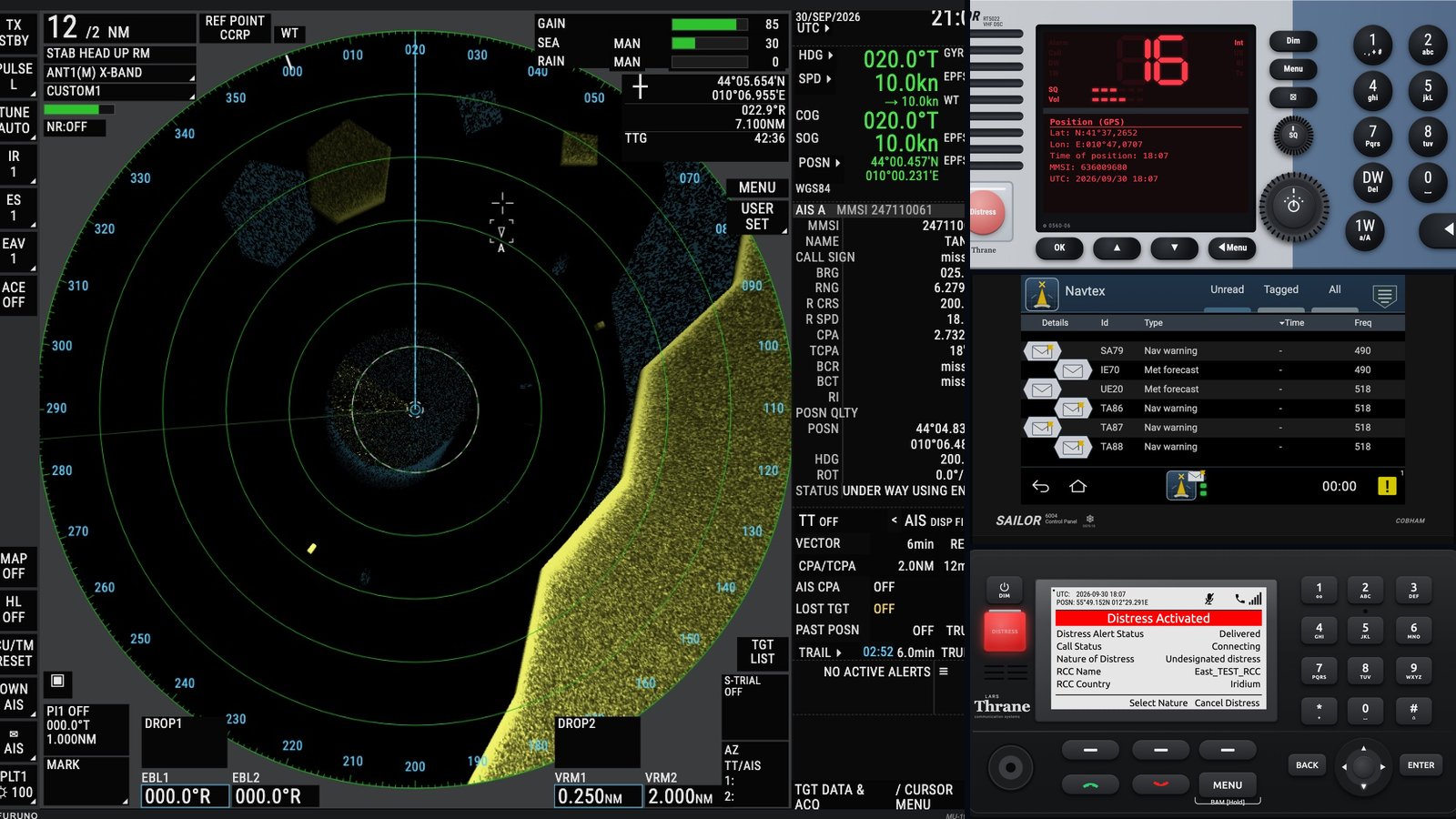
Universo GMDSS Italia entrusted us with their entire simulation department. VHF DSC, MF/HF, Inmarsat-C, Iridium, NAVTEX and an ARPA radar, reproduced key by key from the manufacturers' manuals, running on a server, drawn in the browser. They are live on corsigmdss.it.
01
The job we were given
In September we announced a collaboration with Universo GMDSS Italia, the Bologna school that prepares mariners and yachtsmen for the ministerial GMDSS exam and takes ninety-nine students out of a hundred through it. The first concrete result of that collaboration is now online, and it is bigger than we expected when we started: the school entrusted us with its entire simulation department.
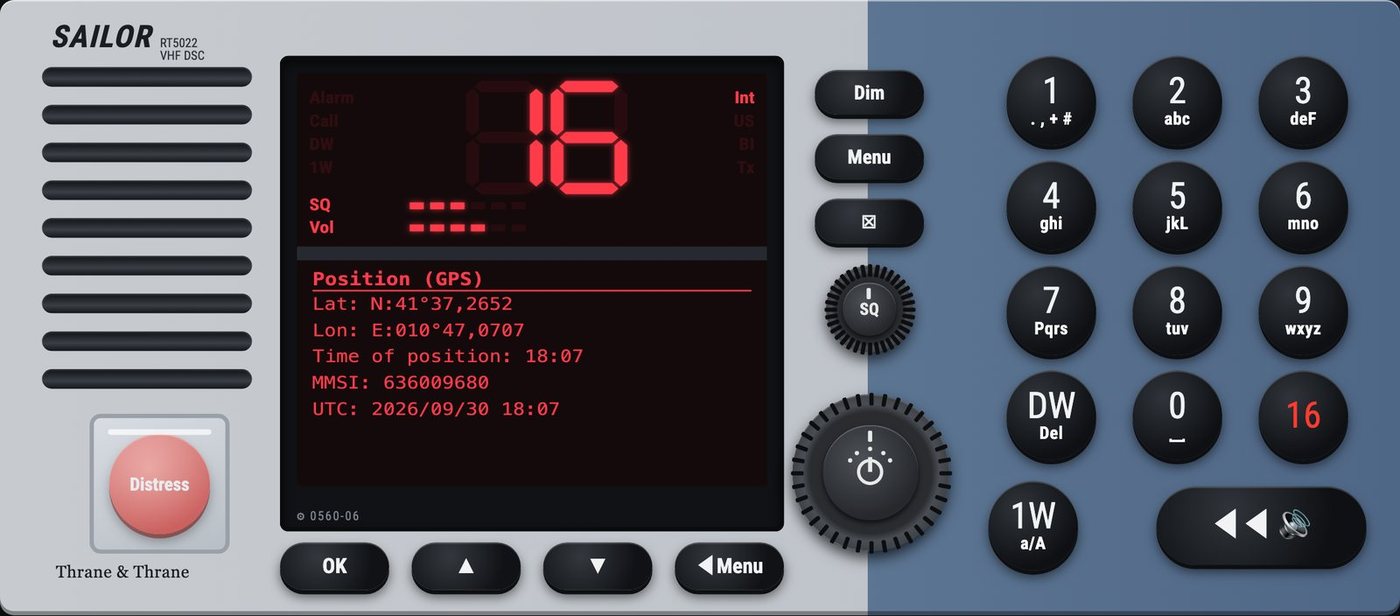
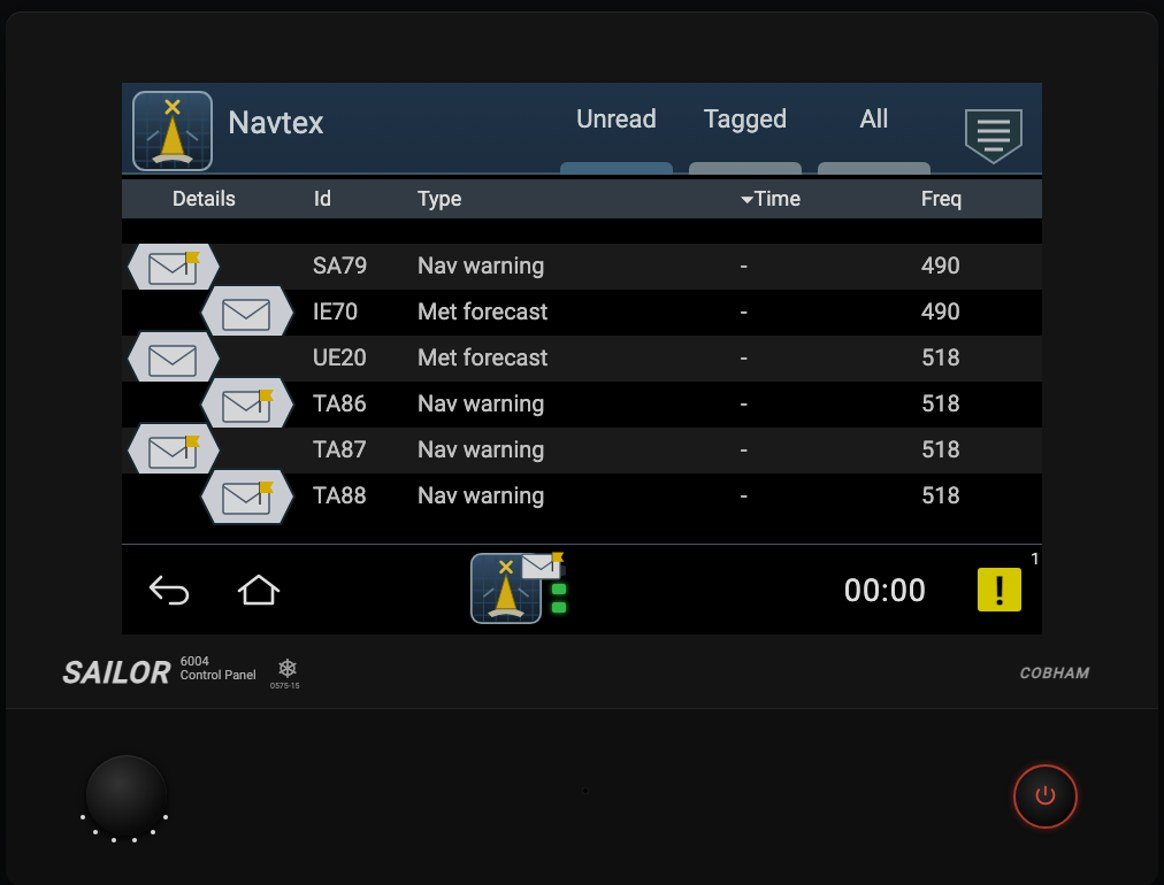
The brief was short and merciless. The exam is taken on real equipment: a SAILOR VHF with digital selective calling, a SAILOR MF/HF control unit, an Inmarsat-C terminal with its eighty-column screen, an Iridium GMDSS satellite phone, a NAVTEX receiver driven from a touch panel. A student who has only seen those devices in photographs freezes in front of the examiner. So the school wanted every one of them reproduced in software, not approximately but exactly: the same keys in the same places, the same menus in the same order, the same timing, the same mistakes when you press the wrong thing. And it all had to run in a browser, on a classroom projector and on a student's tablet at home, with nothing to install.
02
What rebuilding them really took
Faithful is an easy word to write and a hard one to earn. For every device we started from the manufacturers' own documentation, Thrane & Thrane and Cobham for the SAILOR range, Lars Thrane for the Iridium terminal, Furuno for the radar, and from photographs of the actual units in the exam room, firmware version included. The NAVTEX alone meant going through four revisions of the user manual and twenty-eight native screenshots of its 800 by 480 display, measuring the colours and the spacing of every list, so that the simulated panel is indistinguishable from the real one at a glance.
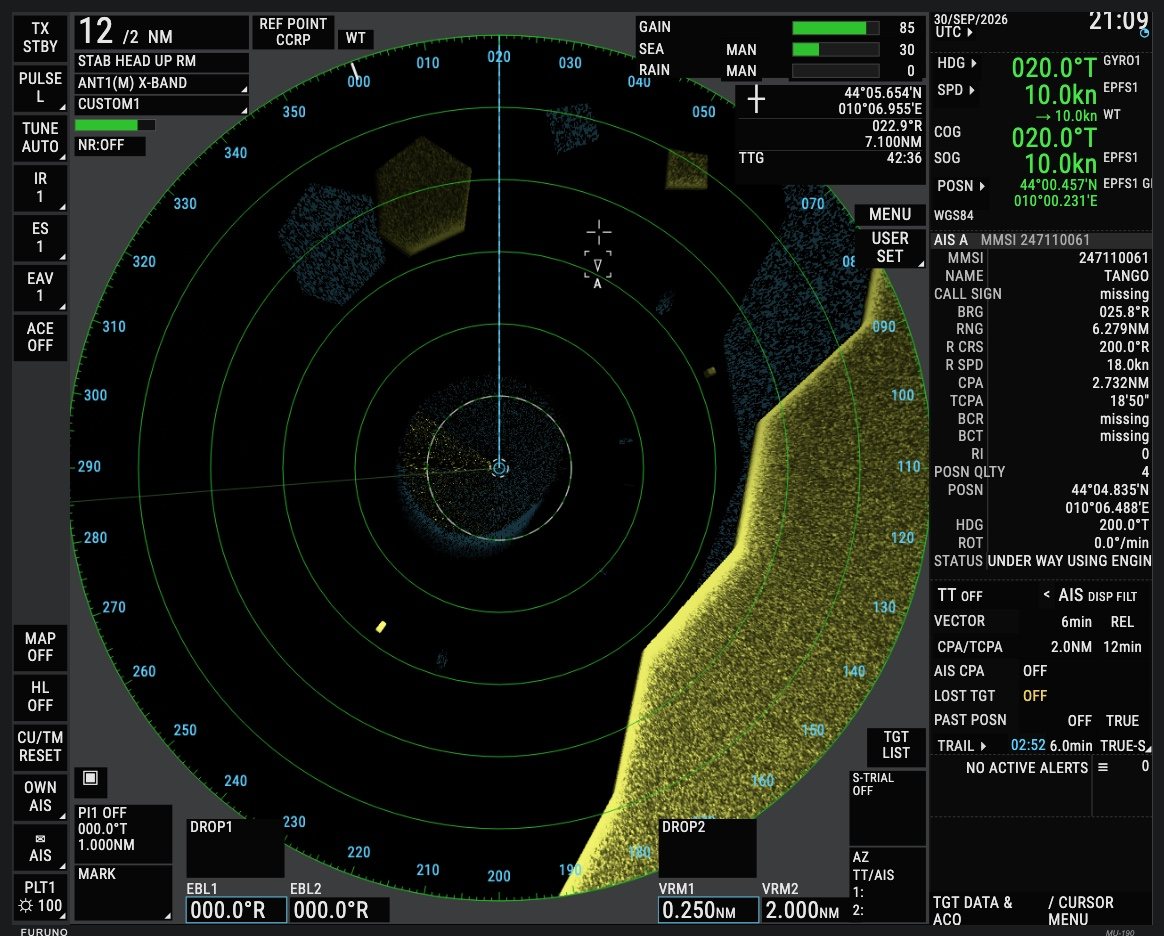
Then there is the behaviour underneath the pixels, which is where most simulators quietly cheat. The receiver keeps two thousand messages per frequency and forgets them after sixty-six hours, as the real one does. A message with serial number zero bypasses every filter, as the rules say it must. The clock starts from zero at power-on when there is no GNSS fix, because that is what the exam unit does on its bench. The DSC calls carry the right format and the right acknowledgement sequence. The Iridium terminal walks through the Distress Alert exactly as the manual documents it, screen after screen. The radar does not play back a picture: its echoes are generated in real time, so GAIN and the sea and rain controls change what you see, bearings and ranges can be measured, and ARPA tracks targets with CPA and TCPA. None of this is visible in a screenshot, and all of it is what makes the hands learn.
The architecture is the other half of the story. Every device is a pure state machine written in TypeScript, running on a server; the browser only receives a snapshot of the screen a few times a second and sends back the key presses. A key press travels there and back in a few hundredths of a second, each student has their own unit that survives a page reload or a dropped connection, and the instructor sees, on the same session, exactly what the student sees. From the instructor panel one launches scenes: a distress call arriving on channel 70, a gale warning on the NAVTEX, a target closing on the bow at seven miles. Every key the student presses is logged in order, which is the fastest way to correct a habit before it becomes an exam mistake.
We will not pretend it was quick. Six devices, each with its own test suite, hundreds of automated checks in total, and several rounds in which a separate reviewer did nothing but try to break them: open the same unit from two browsers, send malformed commands, scroll past the end of a list, pull the power in the middle of a sequence. The bugs found that way were fixed the same day, and the rounds continued until a full day of hunting turned up nothing worth writing down. Perfection is a strong word; what we can say is that we stopped only when we could no longer find a difference.
03
The result
The simulation department lives at corsigmdss.it: six devices, the SAILOR RT5022 and 6222 VHF, the SAILOR CU5100 MF/HF, the TT-3606E Capsat Inmarsat-C, the Lars Thrane LT-3100S Iridium, the SAILOR 6391 NAVTEX and the FURUNO FAR-2228 radar with ARPA. Each has a practice panel for the student working alone and an instructor panel for the classroom. Access is by time-limited code, handed to the school's students; nautical schools and training centres can rent the whole set for their own classrooms. The school describes them on its own site, on the Simulators page.
It is the kind of work BlackOrder exists for: vertical software for people who need it to be right, built from the documentation rather than from the impression, and tested until it stops surprising us. If the sea is your trade, the GOC, ROC, LRC and SRC certifications are prepared with Universo GMDSS Italia, entirely online, and these simulators are now part of how they do it.
See the simulators on corsigmdss.it
Six exam devices in the browser, server-side engine, instructor panel. Access by code; rental for nautical schools.
Visit corsigmdss.itMore from the codex
Discussion 0 comments
No comments yet. Start the conversation.