
AgentOrder: a browser for the agentic web
See how a website presents itself to AI agents. Inspect real discovery documents, MCP servers and tools in a native Mac workspace.
01
The problem
A website has more than one front door. Alongside the pages we read, it can publish manifests, catalogs, machine-readable descriptions and tools that agents can query. Those interfaces are often scattered across HTML links, well-known paths and protocol endpoints.
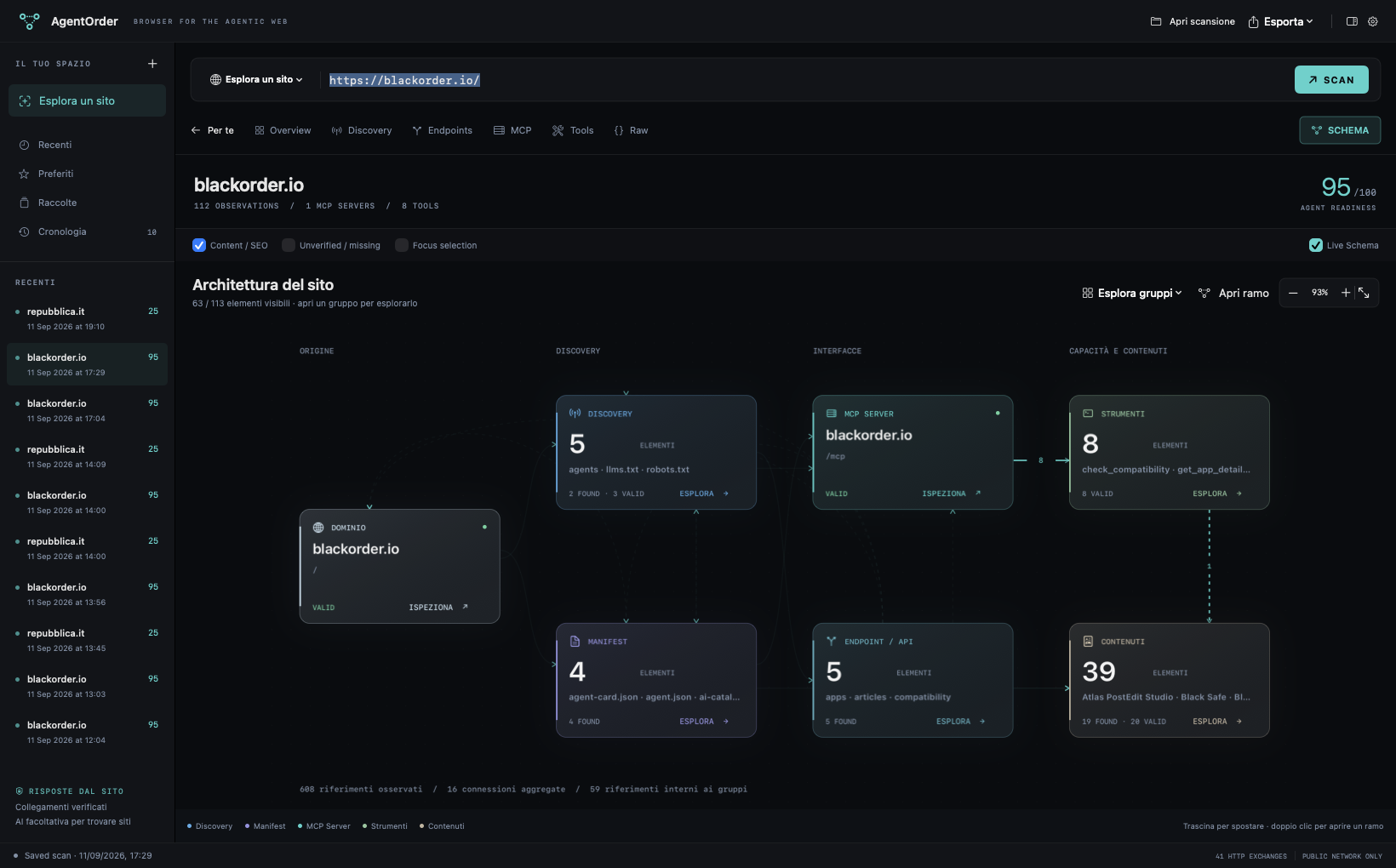
AgentOrder makes that layer visible. Enter a public domain and scan it. The app checks what responds, records the evidence and explains what was found. BlackOrder is a public integration test; the scanner works with other domains too. An ordinary page link is not proof of an agent endpoint or an MCP server.
02
Why it happens on macOS
The Mac provides the right foundation for a focused inspector: a native three-column workspace, local scan history, Keychain credentials and an AppKit/Core Animation graph.
Domain scanning does not require AI or an API key. It inspects HTTP responses, discovery links and supported manifests, then initializes discovered MCP servers and reads their advertised inventories. FOUND, VALID, INVALID, UNREACHABLE and UNSUPPORTED describe different outcomes. A transparent readiness score derives from the implemented checks, with reasons for missing points; it is not an AI opinion.
Optional AI research helps find candidate domains. The same deterministic scanner then checks those candidates. Provider accounts and any search-service credentials are configured separately.
03
My approach
Start with a site
Enter its URL and choose SCAN. The guided view explains published information and available actions. Switch to the technical views for discovery documents, endpoint details, MCP capabilities, tools and raw traffic.
Explore the architecture
SCHEMA starts with readable groups instead of shrinking hundreds of nodes into an unreadable picture. Open a group, search its elements or focus on a branch. Pan, zoom and select nodes to inspect their evidence. Connections come from observed relationships. Live Schema reveals observations as the scan progresses.
Query a tool deliberately
The tool runner builds fields from supported input schemas and validates parameters before sending them. Calls require an explicit RUN; mutating and unknown tools need an additional confirmation. Server annotations inform the classification but do not guarantee a tool's effects. Inspect structured answers and raw messages, then export a scan as JSON, Markdown or PDF.
Keep the boundaries visible
The current client supports MCP Streamable HTTP with JSON and request-scoped SSE responses. Legacy standalone SSE, local stdio, OAuth login and multi-round elicitation are not implemented. Unsupported features are reported as such. Public scanning blocks local and private destinations by default, limits response sizes and time, and never executes code received from a site.
Signed updates
Version 0.1.1 checks the existing BlackOrder update channel automatically, with a manual Check for Updates command and an option to turn automatic checks off. It authenticates the manifest with a pinned Ed25519 public key and verifies the DMG's SHA-256 and size before offering to open it. Installation is the familiar drag to Applications operation. Earlier development builds need this first update installed manually.
AgentOrder is free, signed and notarized, for Apple silicon on macOS 14 or later. Its interface uses Italian when that is the Mac's primary language and English otherwise. Remote source text stays in its original language. Domain mode needs no AI subscription; optional cloud research may incur the selected provider's charges.
More from the codex
Discussion 0 comments
No comments yet. Start the conversation.