The Dark Codex

Chronicles from the order — thoughts on software, security, privacy and independence.

3 articles
20 apps on Store
Portomaggiore, Italy
All macOS (2) Software Design (2) SDR (1) DMR (1) C4FM (1) Ham Radio (1) ApexSDR DMR (1) Digital Voice (1) Amateur Radio (1) Audio (1) PeakLab (1) Waveform Editor (1) Privacy (1) Ethics (1) Anti-Profiling (1)
+

If you have ever tried to decode DMR on your computer, you know the drill.

First you need an SDR application. SDR++, SDR#, GQRX, pick your flavor. Then you need a virtual audio cable to pipe the discriminator output somewhere. Then you need DSDPlus or DSD to actually decode the digital stream. Three separate applications. Configured independently. Connected by virtual plumbing that breaks every time something updates.

Half the posts on ham radio forums are variations of the same question: "I cannot get DSD to work with my SDR, please help." The other half are answers that start with "make sure your virtual audio cable is set to..."

And if you are on macOS? The situation is even worse. The serious decoders are Windows-only. Your options are a virtual machine, a Boot Camp partition, or accepting that digital voice monitoring from your Mac simply is not going to happen.

This is not a minor inconvenience. This is a broken workflow that has persisted for over a decade while DMR has become the dominant digital voice mode in amateur radio.

ApexSDR DMR exists because I got tired of fighting software instead of listening to radio.

I am IU4TPI. I have been a licensed radio amateur for years. I build software professionally. And every single time I sat down to monitor my local DMR repeater from my Mac, I ended up troubleshooting audio pipes instead of copying callsigns. That is not the hobby I signed up for.

So I built what should have existed years ago: an SDR application with digital voice decoding built directly into the signal chain. Not bolted on. Not piped through. Built in.

You will notice something missing from ApexSDR DMR: the waterfall display. That scrolling cascade of color that every SDR puts front and center. It is gone on purpose.

Here is the reasoning. When you are monitoring a DMR repeater on 438.500 MHz, what is the waterfall showing you? A narrow signal appearing and disappearing as people key up. You already know the frequency. You already know the bandwidth. The waterfall is telling you nothing you do not already know. It is eye candy that consumes screen space and processing cycles while adding zero operational value for digital voice monitoring.

ApexSDR DMR shows you what matters: signal level, squelch state, mode, timeslot, color code, talkgroup, source callsign. Information you can act on. Not pixels you stare at.

This is a deliberate design choice, not a missing feature. ApexSDR DMR is a radio, not a spectrum painting application.

The experience is exactly what you would expect from a radio.

Select DMR mode. Tune to your repeater frequency. When a transmission comes in, you hear clear voice. On screen you see the timeslot, color code, talkgroup ID, and source callsign. With an active internet connection, ApexSDR DMR automatically resolves DMR IDs against the global database, displaying the operator's callsign and name in real time. You see who is talking, not just a number. No setup. No configuration wizard. No external software. It just works.

The same applies to C4FM. Select the mode. Tune. Listen. Yaesu System Fusion frames are decoded natively with source and destination information displayed in real time.

To be absolutely clear: this decodes amateur radio digital voice. Unencrypted transmissions as used on ham radio repeaters and simplex worldwide, in full compliance with amateur radio regulations. This is a tool for radio amateurs who want to monitor their local repeater without building a Rube Goldberg machine of software components.

ApexSDR DMR is currently in beta on macOS. The core is solid. Analog reception works. DMR decoding works. C4FM decoding works. We are refining the interface, expanding SDR hardware compatibility, and stress-testing across different repeater configurations before the public release on the Mac App Store.

No SDR application on any platform offers integrated one-click DMR and C4FM decoding. Not SDR++. Not SDR#. Not GQRX. Not CubicSDR. None of them. ApexSDR DMR is the first, and it runs native on Apple Silicon.

This is an open development. If you have ideas, feature requests, or suggestions for what ApexSDR DMR should do next, we want to hear from you. Write to info@blackorder.it and help shape the future of this software. The best features come from the operators who use them every day.

73 de IU4TPI.
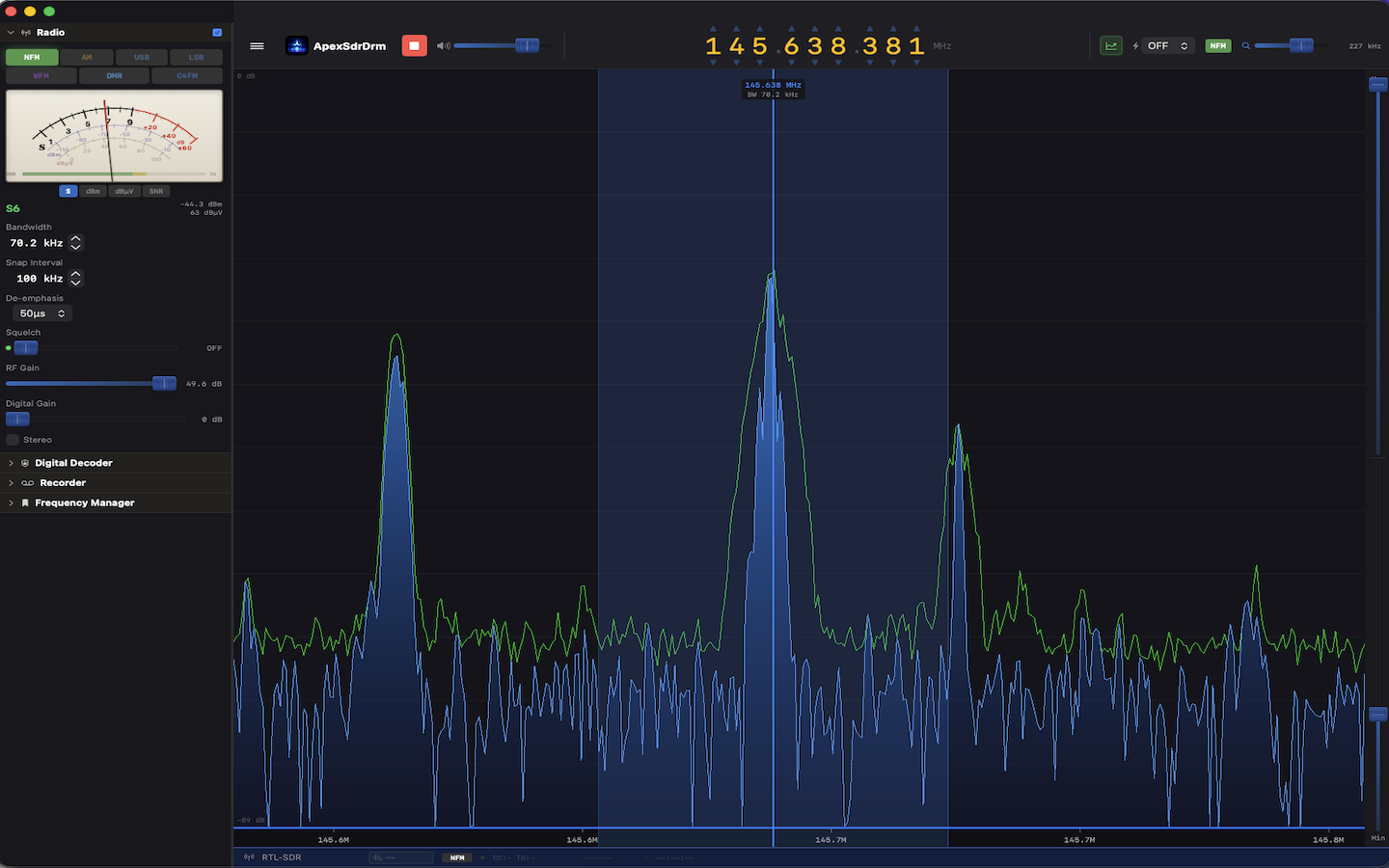
Read full article Beta macOS
ApexSDR DMR: One Click to Digital Voice. No Pipes, No Pain. Preview
+

There was a moment in time when audio editing felt direct. You opened a file, saw the waveform, made the change you needed, rendered, and you were done. No friction. No waiting. No mental overhead. Just you and the sound.

Somewhere along the way, that simplicity disappeared.

Audio tools grew larger, heavier, and more complex. Powerful, yes. But often excessive for the kind of work many creators actually do every day. Editing a voice track. Cleaning a podcast. Trimming a take. Shaping a fade. Fixing a breath. Finalizing a file.

PeakLab was born from the quiet frustration of that gap.

It was built for people who still love working directly on audio. People who want precision without ceremony. Speed without compromise. A space where the waveform is the center of everything again.

From the first moment you open a file, PeakLab feels immediate. The waveform appears instantly, fluid under your cursor, ready to be explored at any scale. You can dive into microscopic detail or glide across long recordings without losing orientation. It feels stable. Grounded. Trustworthy. The way a serious editor should feel.

Editing itself is fast and natural. Cuts land exactly where you place them. Fades shape smoothly and musically. Selections respond with sample-level accuracy. You are never fighting the tool or waiting for it to catch up. The interface stays out of the way so your attention stays on the sound.

This focus was intentional. PeakLab is not a DAW and never tries to be one. It is a dedicated waveform editor designed for the real work that happens between recording and publishing: the quiet, meticulous stage where audio becomes clear, balanced, and finished.

Under the surface, the processing engine was engineered for quality as much as speed. Normalization respects perceived loudness. Time and pitch changes preserve character. Noise reduction works in the spectral domain rather than blunt subtraction. Fades follow equal-power curves so transitions feel natural instead of mechanical. The goal was always transparency: processing that improves audio without leaving fingerprints.

At the same time, PeakLab embraces the modern macOS ecosystem. It opens and exports all major lossless and compressed formats. Audio Units and third-party plugins integrate seamlessly, with full offline rendering through an effect chain. Real-time effects allow quick shaping while you listen. Batch processing and silence detection accelerate repetitive work. Markers, meters, overview navigation, and history tracking support long editing sessions without fatigue.

But features alone were never the point.

PeakLab was created with a very specific user in mind: someone who remembers how satisfying focused audio editing used to feel, and who has been waiting for that experience to exist again on modern macOS. Rebuilt with today's performance, precision, and stability.

It is software made with respect for sound work.
Respect for time.
Respect for the craft of editing itself.

You can open a file, make a precise change, render, and move on. Exactly as it should be.

Read full article App Store
+

If you build software, you are expected to collect data.
If you want growth, you are expected to track behavior.
If you want visibility, you are expected to rank, segment, and optimize people.

This article argues that none of this is inevitable.

Profiling Is Not Neutral

User profiling is often justified as “personalization” or “better user experience.”
In practice, it acts as a selection mechanism.

Profiling systems do not merely adapt interfaces. They decide:
who gets visibility
who gets promoted
who gets funded
who gets ignored

The result is a web where access is not based on merit, quality, or contribution, but on prior visibility, social capital, and algorithmic favor. The more data you already generate, the more the system amplifies you. Those without an audience remain invisible, regardless of value.

This is not a technical limitation. It is a design choice.

A Different Design Philosophy

The strategy behind my software projects is simple:
build systems that work without profiling users at all.

This means:
no behavioral tracking
no demographic inference
no psychological segmentation
no hidden scoring systems

Users are not reduced to data profiles. They are participants.

Registration, when required, is minimal. Usually limited to an email and a name. No age, no interests, no inferred identity. The system does not need to “know” the user to function.

This constraint is intentional. It forces different architectural decisions.

From Ranking to Rotation

Most platforms rely on ranking. Ranking inevitably concentrates attention.

Instead of ranking, my projects use rotation.

Content, visibility, and exposure are distributed over time rather than optimized for engagement. Everyone has access to the same opportunity space. The system does not reward those who already have reach, money, or external traffic.

Rotation is not randomness. It is fairness implemented as infrastructure.

This approach is currently used in Parole Da Leggere, a writing platform where authors rotate democratically on the homepage. Visibility is not earned through followers, ads, or optimization tricks. Every contributor is treated equally by design.

Why This Matters Beyond Content Platforms

The same logic applies to crowdfunding, marketplaces, and digital communities.

Most crowdfunding platforms are not democratic. They require creators to bring their own audience. Funding success depends more on external visibility than on the idea itself.

A profiling-free, rotation-based discovery model would allow ideas to surface based on exposure equity, not pre-existing influence.

This is not about removing competition. It is about removing structural bias.

Privacy as a Consequence, Not a Feature

In this model, privacy is not a marketing feature.
It is a consequence of architectural restraint.

When you do not profile users:
there is less data to secure
fewer compliance risks
lower incentive for surveillance-based monetization
higher trust between platform and user

The system becomes simpler, more robust, and more transparent.

The Future Is Not Bigger Algorithms

The future of the web does not need more data, deeper profiling, or stronger prediction models.

It needs:
fair distribution of attention
systems that do not punish invisibility
platforms that do not require surveillance to function

Profiling is a shortcut, not a necessity.

Building software without it is harder at first, but more sustainable in the long run. Not because it is ethically fashionable, but because it restores balance between people and platforms.

This is not a return to the early web.
It is an evolution beyond its worst habits.

Read full article